SWOT Analysis
SWOT Analysis
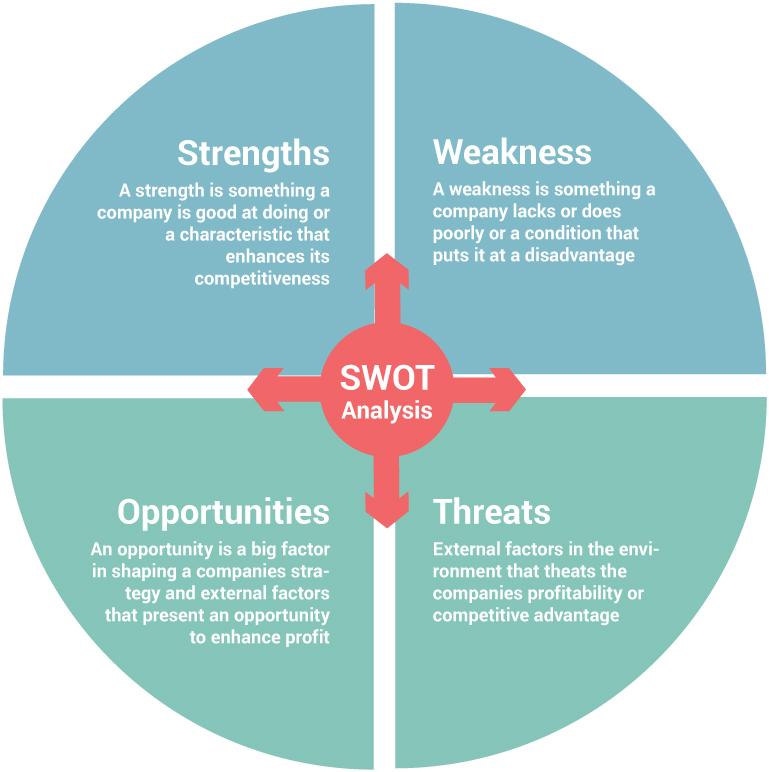
SWOT Analysis was originally developed by Albert Humphrey in the 1960s, and has become a common and useful technique for identifying a business’ internal factors (e.g. strengths and weaknesses) and its external factors (e.g. opportunities and threats).
There are many benefits of SWOT analysis:
- It is low cost to conduct
- It helps to understand your business and competitors
- Provides useful critical information that can be used for forecasting; helps decision makers address weaknesses and threats and capitalise on strengths and opportunities.
It is important to note that this technique can help to identify and understand key issues affecting the organisation, but it does not offer solutions as it is subjective, and the data used in the analysis may be based on unreliable assumptions. Regardless of the limitation, the benefits outweigh the limitations.
Using SWOT Analysis on Planium Pro
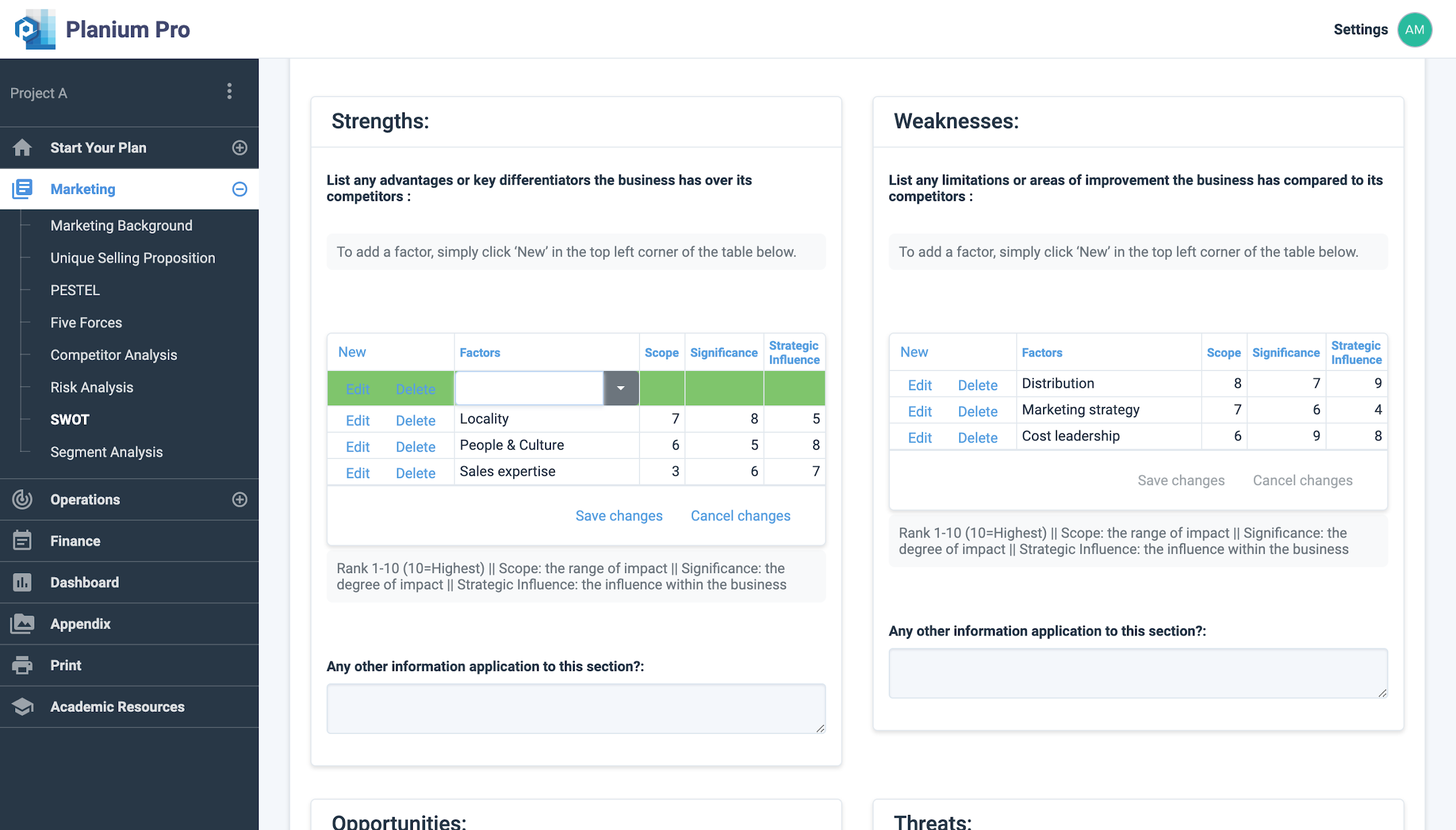
To complete this section, on the left-hand side menu bar, click the + to expand the ‘Marketing’ menu and select ‘SWOT’. To add a new factor, click on ‘New’ in the top left corner of each table. When an empty field appears, add in the factor and rank it on:
- Scope: the range of impact
- Significance: the degree of impact
- Strategic Influence: the influence within the business
Strengths
List any advantages or key differentiators the business has over its competitors. Questions to consider asking about the business are:
- Does the business have any existing proven product and/or design concepts with fulfilled sales orders?
- Does the business have any unique patented positions in a niche area with premium capacity?
- Does the business have any worldwide brands or reputation in the field of play?
- Does the business have a diverse customer type or broad geographical reach?
Weaknesses
List any limitations or areas of improvement the business has compared to its competitors. Questions to consider asking about the business are:
- Are there any constraints against local or global objectives and market potential?
- Are there any areas that competitors have an advantage or edge?
- Is there any necessary expertise, licenses or inputs that is currently lacking?
- Are there any financial constraints that may weaken the prospects of the business?
Opportunities:
List any opportunities that exist for the business, such as emerging needs or underserved markets. Questions to consider asking about the business are:
- Are there any pent-up customer demands in current markets that could be met?
- Are there any economical, social or political trends that the business could potentially benefit from?
- Are there any competitor or supplier weaknesses that the business could potentially benefit from?
Threats:
List any threats that exist for the business, such as new competitors, negative media, or customer attitudes. Questions to consider asking about the business are:
- Are there any negative political and social trends impacting on the business?
- Are there any negative economic trends impacting on the business?
- Are there any negative technological trends impacting on the business?
- Are there any customer or supplier weaknesses that may damage the business?
Click ‘Save’ to save changes.
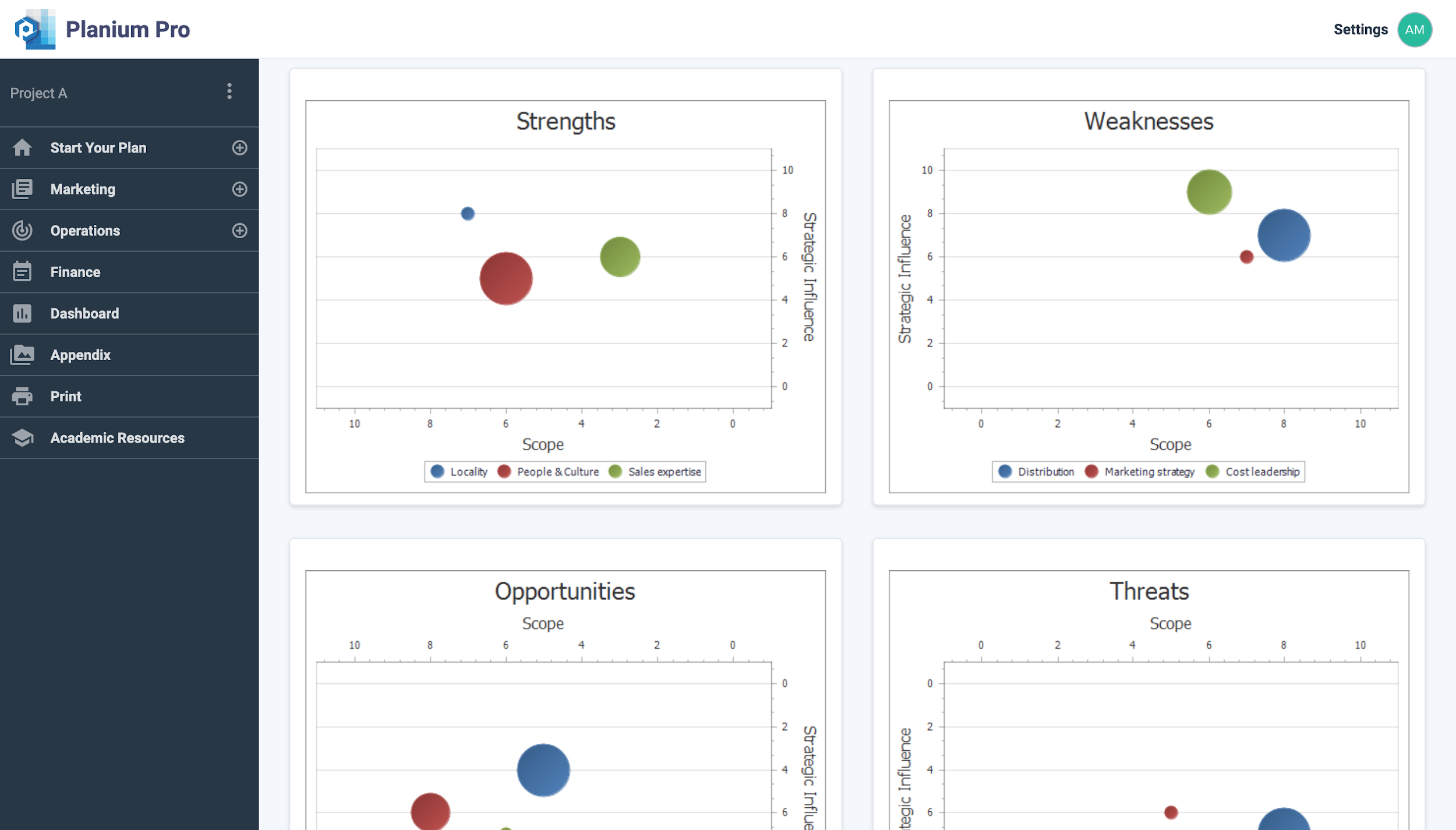
Click ‘Chart Preview’ to view the analysis results.
Analysing Five Forces Results on Planium Pro
Under ‘SWOT Introduction’, you can input any introductory information that may benefit your client or investor.
‘Analysis Results’ is the section to write-up the analysis on the graph and describe any key themes that are present in the data.
Click ‘Save’ to save changes.
Click ‘Report Preview’ to view the write-up in report format.